An AI music robot can turn a written prompt into sound, play an instrument, or change a live performance as it runs. The useful question is where that system saves work, and where its choices still need a person’s judgment.
- Faster drafts from a short text prompt
- Physical robots can repeat a timed musical action
- Copyright, control, and live-performance limits remain
What these robots actually do
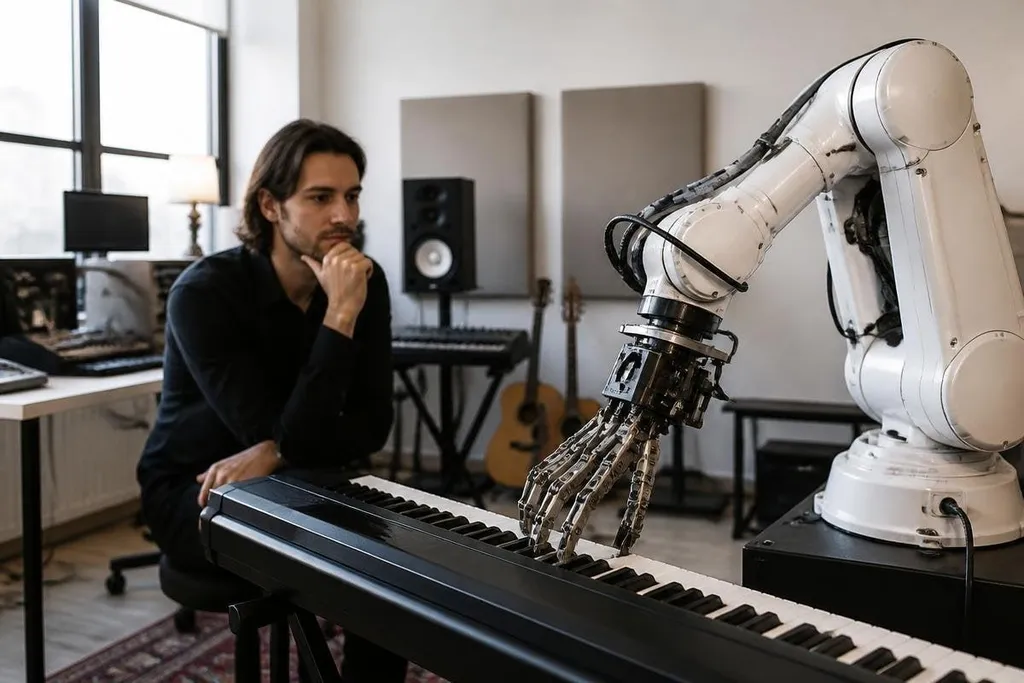
The term covers two different kinds of systems. Software can generate melodies, rhythms, lyrics, or backing tracks, while a physical robot uses motors and actuators to strike keys, pluck strings, move a bow, or control another instrument.
AI software usually works from patterns in its training data. It turns a prompt or musical input into a sequence of notes, sounds, or control signals. A physical robot then needs a separate control system to turn those signals into movement with the right timing and force.
That split matters. A generated track may sound complete but still need editing. A robot arm may hit the correct notes yet struggle with small changes in tempo, instrument tension, or room acoustics. The system can follow a plan, but a person still has to check the result.
Where the benefits show up
For a producer, the main gain is speed during early work. A system can create several rough arrangements from the same idea, giving the producer material to edit instead of starting with an empty project.
That use works best when the task has a clear boundary. A robot can repeat a drum pattern, hold a steady tempo, or test a short musical phrase while a musician studies the result. Repetition also helps when a performance needs many takes with the same timing.
Physical systems may help in teaching and research too. Students can compare different grip forces, note timings, or motion paths without asking a person to repeat the same movement for every trial. The useful output is the recorded result, not the claim that the robot has musical taste.
In a live performance, a mistimed strike affects the sound, while a misplaced arm can affect the person beside it. Robot24.com's robotics reporting can tie the software claim to the robot's control system and test setting. That evidence leads into the risks of putting music robots near people.
Where the risks start
Training data raises a direct ownership problem. If a system learned from protected recordings, the person using it may not know which works shaped the output or whether the training process had permission. A generated song can also resemble an existing style closely enough to create a dispute, even when no single source is copied in full.
Control is another limit. A prompt describes an idea in words, but music contains choices about timing, tone, structure, and performance. The system may fill in those gaps in ways the user did not expect. That makes review necessary before a track reaches a client, audience, or platform.
Physical robots add safety concerns. Moving arms, strings under tension, sharp tools, and loud sound levels can hurt people or damage equipment. A safe setup needs a clear stop control, limits on movement and force, and enough space around the instrument.
Privacy can enter through voice recordings and live sessions. If a system processes a singer’s voice or a band’s unfinished work, the operator needs clear rules for storage, access, and deletion. A low purchase price does not remove those duties.
A practical decision guide
Use this checklist before buying or building a music robot:
- Define the job: name the musical task, the expected output, and the person who approves it.
- Check the input: find out whether the system accepts audio, notes, text, motion data, or a mix.
- Test control: measure how easily you can change tempo, force, tone, and the length of a passage.
- Review ownership: read the terms for training data, generated files, voice recordings, and commercial use.
- Set safety limits: place the stop control within reach, restrict motion, and protect people near the instrument.
- Plan failure recovery: decide what happens when the network drops, a sensor gives a bad reading, or the robot repeats a wrong action.
A small studio may gain more from software that produces editable drafts than from a motorized performer.
A school or research lab may value repeatable motion, provided staff can inspect the control code and stop the machine quickly. I'd skip any system that hides its training terms or gives you no clear way to review its output.
The next useful test is simple: run the same musical task with a person, the AI system, and the robot hardware, then record the time, edits, safety stops, and ownership questions each version creates.